
ADEMOLLO Luigi
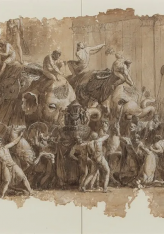
ADEMOLLO Luigi
Luigi Ademollo (Milan, 1764 – Florence, 1849) was an Italian painter and decorator associated with the transition between the Baroque tradition and Neoclassicism, renowned for his theatrical decorations and large-scale fresco cycles inspired by history and religion.
He began his artistic training at the prestigious Accademia di Belle Arti di Brera in Milan, where he studied under prominent figures such as Giuliano Traballesi, Giocondo Albertolli, and Giuseppe Piermarini. This academic environment, rooted in classical ideals, deeply shaped his artistic language and his lasting interest in antiquity.
In 1788, Ademollo moved to Florence, a decisive step in his career. The following year, he executed the stage decorations for the Teatro della Pergola, a commission that brought him immediate recognition. In the same year, he was appointed professor at the Accademia di Belle Arti di Firenze, confirming his status within the Florentine artistic milieu.
Ademollo spent most of his life between Florence and Rome, developing a prolific career as a decorator. His work reflects not only technical mastery but also a considerable literary and historical culture, which nourished his richly narrative compositions. He contributed to major decorative campaigns in prestigious sites such as the Palazzo Pitti—notably in its chapel and several state rooms—as well as the Basilica della Santissima Annunziata. He also worked for aristocratic residences including the Pucci and Capponi palaces, and carried out commissions for churches across various Italian cities, notably in Bergamo, Brescia, Lucca, Livorno, Pisa, and Siena.
In Arezzo, Ademollo produced an important cycle of frescoes depicting scenes from the Old and New Testaments, demonstrating his ability to handle complex iconographic programs on a monumental scale.
A versatile and erudite artist, Luigi Ademollo stands out as a major figure of Italian decorative painting at the turn of the 18th and 19th centuries, whose work bridges the grandeur of the Baroque tradition with the clarity and moral ambition of Neoclassicism.