PROST Maurice
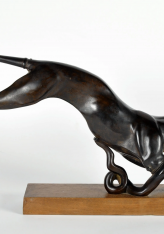
PROST Maurice
Maurice Prost (born March 13, 1894, in Paris – died July 3, 1967) was a French animal sculptor renowned for his precision, technical mastery, and dedication to direct carving. Trained in drawing under Léopold Morice, he discovered his true artistic calling through Charles Valton, a leading figure in animal sculpture.
After an apprenticeship in metal chasing with the Parisian goldsmith Gauthier, Maurice Prost developed a strong technical foundation that would shape his sculptural work. Despite losing his left arm during World War I, he pursued his artistic career with determination and gradually established himself within the French sculpture scene.
From 1918 onward, he studied animals at the Jardin des Plantes in Paris, which became a central source of inspiration for his work as an animal sculptor. He opened his first studio in 1920 and began exhibiting in 1921 at the Salon des Artistes Français, as well as at the Salon d’Automne and the Salon des Artistes Indépendants, where his animal sculptures gained increasing recognition.
In 1922, Maurice Prost adopted the technique of direct carving in stone, which he further developed by inventing and adapting a pneumatic hammer in 1927 to accommodate his disability. This innovation enabled him to create large-scale and monumental sculptures independently.
A recognized and widely exhibited artist, he participated in major exhibitions, notably presenting his life-size black panther in bronze in 1931. In 1937, he created two monumental Pegasus sculptures for the International Exhibition of Arts and Technology in Paris, solidifying his reputation as a leading French animal sculptor.
After World War II, Maurice Prost produced numerous public commissions and monumental works. He also taught drawing for over twenty years and collaborated with the Monnaie de Paris between 1961 and 1965 on a series of medals.
Awarded numerous distinctions, including several medals at the Salon des Artistes Français and the Legion of Honour, Maurice Prost remains an important figure in 20th-century animal sculpture. His work is distinguished by its naturalistic approach, technical excellence, and deep sensitivity to the animal world.