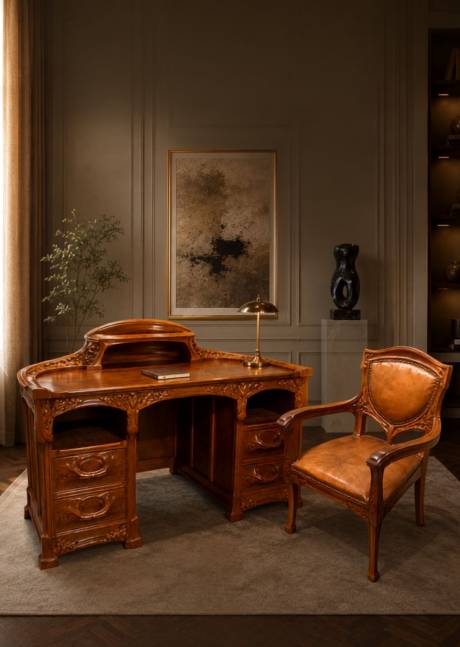
Hector Michaut, rare seaweed-patterned desk and its armchair
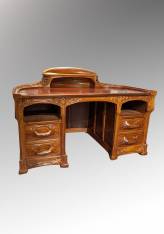
Hector Michaut, rare seaweed-patterned desk and its armchair
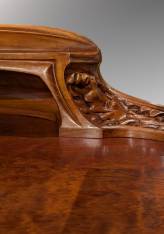
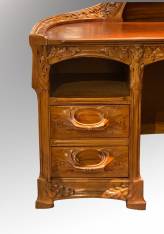
Carved and moulded walnut kidney-shaped desk resting on two pedestal bases, created in 1923 by Hector Michaut. Produced during the cabinetmaker's final creative period, this remarkable piece perfectly illustrates the refined ornamental language of the Lorraine Art Nouveau movement, of which Michaut was one of the leading exponents. The decoration, entirely centred on finely carved seaweed motifs, extends across the moulded frieze, the openwork drawer handles, the uprights and the raised gallery, continuing seamlessly onto the reverse of the desk, a testament to its exceptional craftsmanship. Signed, inscribed "Paris" and dated on the right-hand side, this desk is illustrated in the reference publication devoted to Hector Michaut and stands as a rare example of the work of this now rediscovered cabinetmaker, reflecting the outstanding quality of the École de Nancy at the close of the Art Nouveau period.
Bibliography: Hector Michaut, ébéniste oublié de l'Art nouveau, Frédéric Descouturelle and Anne Billant, Société Lorraine des Amis des Arts et des Musées, 2023, p. 68 (black-and-white illustration).
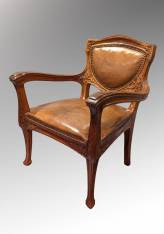
Carved and moulded walnut armchair, created in 1923 by Hector Michaut. Featuring a generously proportioned seat and an oval medallion back surmounted by a boldly moulded crest rail, it is upholstered in Havana-brown leather that beautifully complements the warmth of the walnut. Faithful to the ornamental vocabulary developed by the cabinetmaker, finely carved seaweed motifs embellish the arm supports, the front seat rail, the uprights and the back rail, creating a harmonious balance between sculptural vitality and elegant design. Signed, inscribed "Paris" and dated on the left-hand seat rail, this armchair was conceived as the natural companion to the matching kidney-shaped desk, together forming a particularly rare and important Art Nouveau office suite. It is a remarkable testament to Hector Michaut's final creative period and to the refinement of the Lorraine Art Nouveau tradition.