DECOEUR Emile
DECOEUR Emile
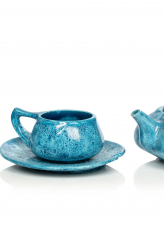
Émile Decœur (1876–1953) was one of the leading figures of French ceramics in the early 20th century. Born in Paris on 27 April 1876 and orphaned at the age of thirteen, he entered the workshop of Edmond Lachenal the following year as an apprentice—a formative experience that would shape his entire career. Decœur soon turned away from faience to devote himself to stoneware, convinced of the profound unity between material and decoration, and influenced by the rediscovery of East Asian stonewares in France at the time.
From 1900 onward, he exhibited independently and developed a distinctly personal style characterized by great sobriety, emphasizing pure forms and the quality of his glazes. After establishing his studio in Fontenay-aux-Roses in 1907, he received the support of the collector Atherton Curtis and the art dealer Georges Rouard, both of whom played key roles in the dissemination of his work. Early in his career, his pieces entered national collections, and in 1926 he was appointed Officer of the Legion of Honour.
Active in major salons and international exhibitions—including the 1925 Exposition of Decorative Arts—Decœur contributed to the evolution of ceramics toward the refined aesthetic of Art Deco. In 1927, he developed a new clay body, halfway between stoneware and porcelain, marking the beginning of a more delicate phase in his production and expressing his pursuit of a “pure art,” in which decoration nearly disappeared in favor of perfect form and material.
Appointed artistic advisor to the Sèvres National Manufactory in 1942, he resumed his personal work after the war and continued his research until his death on 16 August 1953 in Fontenay-aux-Roses, where he is buried. His oeuvre—both rigorously experimental and deeply sensitive—remains a pinnacle of French ceramic art.