
BRIARD Michel
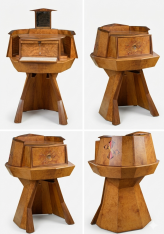
BRIARD Michel
Born in Saint-Lô in 1930, Michel Briard was a French cabinetmaker renowned for the virtuosity of his marquetry work and for a body of work situated between traditional craftsmanship and contemporary creation. He settled in Agneaux in 1955, where he practiced his craft until retirement, while continuing his artistic work afterward.
His vocation emerged at an early age following a painful experience at school when he was thirteen years old. After beginning his career with an upholsterer in Saint-Lô and later working for a large firm in Bernay, he completed his military service before returning to Agneaux, where he established his first workshop in his grandmother’s home.
During the early years of his career, Michel Briard devoted himself mainly to restoring furniture and creating reproductions of eighteenth-century pieces. Seeking to establish himself in the profession, he entered several competitions. In 1968, he was awarded the National Gold Medal for Arts and Crafts for one of his creations.
His reputation truly grew during the 1970s. In 1976, he took part in the nationally televised competition “Artisan de la vertu,” followed by several exhibitions, notably at the Salon des Artistes Décorateurs at the Grand Palais in Paris. This period marked the revival of his personal creative work. Michel Briard developed a distinctive style combining elegant forms, highly accomplished marquetry, and a taste for hidden mechanisms: each of his pieces incorporated concealed drawers or secret compartments, playful details he particularly enjoyed.
In 1981, one of his combination tables was purchased for French President François Mitterrand and placed in the Élysée Palace as part of the renewal of the presidential furniture collection with contemporary works. Michel Briard also collaborated with Michel Boyer and created, together with Guy de Rougemont, a desk ensemble entitled “Diderot,” published by Artcurial.
Throughout his life, the cabinetmaker produced unique works sold in France, the United States, England, and Germany. Chests of drawers, tables, tallboys, and wooden artworks depicting landscapes, animals, and portraits reflected his constant desire “to see how far [he] could go with wood.” His artistic universe gradually filled his home, where he lived surrounded by his own creations.
Despite increasingly poor eyesight in his later years, Michel Briard continued working with wood until the end of his life. In 2024, at the age of ninety-four, he declared: “My hands are what guide me.” Physically marked by his trade — he had lost two fingers on his right hand in work accidents he considered common among cabinetmakers — he nevertheless pursued his work with philosophy, still creating one unique piece every year.
Cabinetmaking remained for him far more than a profession: it was a vital passion that helped him endure difficult trials, notably the death of his wife, Odile. Michel Briard passed away in 2025, leaving behind the legacy of a singular master craftsman, celebrated for his marquetry, his secret-compartment furniture, and his position at the crossroads of tradition and contemporary invention.