BAUQUIER Georges
BAUQUIER Georges
A French painter, born in Aigues-Mortes and died in Callian. From an early age in Nîmes, he showed a marked talent for drawing. In 1934, he entered the École des Beaux-Arts in Paris, then in 1936 joined the School of Contemporary Art directed by Fernand Léger, where he became the massier (studio head) and one of Léger’s closest collaborators. Politically engaged, he joined the Communist Party and took part in the Resistance before being imprisoned at La Santé Prison in 1944.
After the war, Bauquier rejoined Léger and participated in many of his artistic and decorative projects. When Léger settled in Biot in the early 1950s, Bauquier assisted him in creating large ceramic sculptures. Following the painter’s death in 1955, Georges Bauquier and Nadia Léger undertook to preserve and promote the work of the man they regarded as one of the masters of modern art.
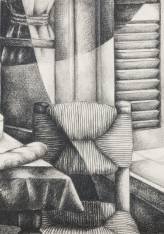
Alongside his role as conservator and advocate of Léger’s legacy, Bauquier pursued his own work as a painter. Encouraged from the outset by Léger, he exhibited at the Louis Carré Gallery in 1953 and the Bernheim Gallery in 1955, before continuing a discreet yet coherent body of work distinguished by structural rigor, vibrant color, and a balance between figuration and abstraction. His compositions—often centered on still lifes, interiors, or landscapes—reveal a refined graphic sensibility and a quest for clarity inspired by Braque and Cézanne.